Custom Medical Chart Dividers & Tabs — From $5.45/Set
By Tabzoola · Updated October 2026
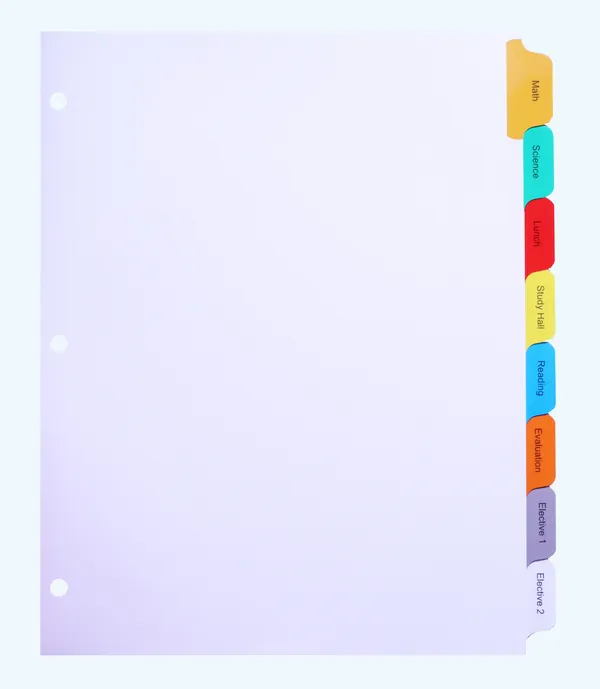
Tabzoola Medical Chart Divider Tabs (8-Tab Set)
Letter size, eight tabs in one bank (1/8 cut), white 90# index with clear Mylar on every tab, collated in chart order, 3-hole punched.
Tabzoola prints this set in this order:
- Patient Information
- History & Physical
- Progress Notes
- Medications
- Labs
- EKG / Diagnostics
- Consults
- Miscellaneous
| Sets | Per set | Total |
|---|---|---|
| 25 | $8.17 | $204.30 · ships free |
| 50 | $4.93 | $246.60 · ships free |
| 100 | $3.75 | $375.20 · ships free |
| 250 | $2.61 | $653.00 · ships free |
Tabzoola prices, setup included, no sales tax added. Every section name is yours to change, and the price updates as you do. Free PDF proof before anything prints.
Prices verified against the Tabzoola pricing engine, the one checkout uses, on October 14, 2026.
Need them fast? Tick Tabzoola's 3-Day Rush at checkout (+40%, $75 minimum) and it ships 3 business days after you approve your proof. See your delivery date →
Tabzoola is a US manufacturer and supplier of custom medical chart dividers and patient chart tabs, made to order in Schaumburg, Illinois by Anselmo Die & Index, Inc. — the family-owned plant that has die-cut index tabs since 1993 and trades online as Tabzoola, shipping nationwide. Medical chart divider tabs, medical chart divider sets, chart divider tabs and patient record dividers are the same product under different names — every set here is printed to your own section titles rather than a stock list.
Medical practices, clinics, and records departments use color-coded chart tabs to find sections fast and keep patient records consistent across every file. Tabzoola prints custom medical chart dividers to your section names and color scheme — collated and ready to assemble, from a 25-set minimum, with paper sets produced in about 5 business days from proof approval.
Tabzoola makes chart dividers two ways: durable poly that wipes clean and stands up to daily handling, or Mylar-reinforced paper for a lower-cost set that still resists tearing — 19 Mylar colors and 11 poly colors, mixed within a single set at no extra charge. Medical tabs, medical index tabs, medical chart divider tabs, patient record dividers — they are all names for the same product, and here you design them yourself with instant pricing and a free PDF proof before anything prints.


Watch page & full transcript →
Color-coded for fast section lookup
Assign a color to each section — labs, progress notes, medications, imaging, billing — so staff can flip to the right place at a glance. Tabzoola offers 19 Mylar colors and 11 poly colors, and you can mix colors within a single set.
Poly or paper — built for daily use
Poly chart dividers for medical records are water-resistant and wipe clean, which is why busy records rooms prefer plastic. Paper chart tabs with Mylar reinforcing cost less and still hold up in three-ring charts. Both can be 3-hole punched and printed on one or both sides.
- Poly: wipe-clean, tear-resistant, body printing available
- Paper: Mylar edge-reinforced, 19 color options, lower cost
- Custom section names, color-coded, collated into sets
The standard chart sections, printed your way
Most practices divide charts into a familiar set of sections — and a custom set means the tabs match your workflow instead of a catalog's guess:
- Demographics / Patient Information: identity, contacts, and the face sheet.
- History & Physical (H&P): patient background and the initial exam.
- Progress Notes: dated visit and rounding notes from clinicians.
- Labs & Diagnostics: lab reports, imaging, EKG and test results.
- Medications / MAR: current medications, allergies, and the administration record.
- Consents & Legal: signed consents, advance directives, and releases.
- Insurance & Billing: coverage, authorizations, and claims.
- Correspondence: referrals, letters, and outside records.
Still need paper in an EMR world? Most practices do
Electronic records didn't end paper charts — they changed what the paper is for. Practices keep physical charts for intake packets and signed consents, downtime procedures when systems are offline, records that must travel (surgeries, referrals, home visits), long-term-care and behavioral-health documentation, and audit binders. Those working charts get handled constantly, which is exactly when flimsy dividers fail.
Custom chart tabs make the paper side of a hybrid workflow fast: consistent sections across every chart, color coding that can be read across the room, and durable construction that outlives the chart itself.
Built for years of daily handling
Choose Mylar-reinforced paper tabs for economical charts, or .015 poly (plastic) tabs where charts face moisture, gloves, and constant pulls — poly shrugs off what tears paper. Both take 3-hole punching for standard chart rings and arrive collated so every chart assembles identically.
Customization options for custom medical chart dividers
Every custom medical chart divider set is built from four choices — tab text, material, colors and cuts, and hole punching:
- Tab text & titles: print custom text or clinical section titles, up to 2 lines per tab, in Arial, Arial Narrow, or Times New Roman — bold, italic, or underlined, at 8 to 18 pt.
- Materials: 90# or 110# index paper, with optional Mylar edge reinforcing, or .015 gauge poly (plastic) that wipes clean.
- Colors & cuts: 19 Mylar colors and 11 poly colors, mixable within one set; cuts run 1/2 through 1/15, with 1/8 and 1/10 the records-room standards for charts.
- Tab position: side-opening tabs are standard for ring binders; bottom-opening (hanging) tabs keep the same portrait sheet with the tab hanging half an inch below it, finishing 8.5″ × 11.5″, for charts pulled from the front; top and short-edge positions are quoted.
- Hole punching: unpunched or standard 3-hole punched; other ring patterns are quoted.
Ordering details: minimums, pricing, and turnaround
Minimum order is 25 sets, and there is no quote step — the price updates as you build the set:
- Paper, 8-tab chart set: $8.00 per set at 25 sets, $3.58 at 100 sets, $2.44 at 250 sets. At Tabzoola, a 5-tab set is $5.45 per set at 25 and $1.57 at 250. Setup is $30.
- Poly, 8-tab chart set: $40.80 per set at 25 sets, $16.56 at 100 sets, $9.92 at 250 sets. Poly carries a $400 tooling setup, so it earns its keep on larger runs.
- Volume price breaks apply automatically at every quantity tier, up to 1,000 sets.
- Turnaround: paper ships about 5 business days after proof approval, poly about 15. Free UPS Ground on US orders over $75.
- Every order includes a free PDF proof — nothing prints until you approve it.
Side tabs or bottom tabs? What the chart format decides
A three-ring patient chart usually takes side tabs, stepping down the binding edge so the sections read top to bottom when the chart lies open. A chart folder that is filed on a shelf and pulled from the front is easier to work with using bottom-position (hanging) tabs, because the labels face you as the folder is drawn out.
Tabzoola cuts both from the same order screen: side tabs or bottom tabs, on a letter or legal sheet. The layout changes where the tab sits on the sheet, not what you can print on it — the section names, colors, and cut stay yours either way. Three letter layouts order online — portrait side tabs, the landscape hanger (a letter sheet turned sideways, bound across its 11″ top), and portrait bottom tabs — plus side and bottom tabs on legal.
Records-supply catalogs name the same product by position: end tab chart dividers are the shelf-filing term for tabs on the side edge, and top tab chart dividers put the tabs along the top — a short-edge position Tabzoola quotes on request. Whichever name your ordering system uses, it's the same die-cut divider with your sections on it.
- Side tabs — three-ring charts opened flat on a desk
- Bottom/hanging tabs — shelf-filed folders pulled from the front
- Both available in poly or Mylar-reinforced paper
How many sections, and the cut that fits them
Chart sets run longer than ordinary binder dividers. A compact chart might use 5 or 6 sections; a full patient record with history, progress notes, labs, imaging, medications, consents, correspondence and billing runs past 10. The tab cut has to fit that count without crowding the text.
A 1/5 cut gives the widest, most readable tab face but only five positions before the pattern repeats. For longer chart sets the 1/8 and 1/10 cuts are the records-room workhorses: enough positions for a full chart in one bank, still wide enough for a word like MEDICATIONS. Tabzoola cuts every standard position from 1/2 through 1/15, so the set is built around your section list rather than your section list being trimmed to fit a stock pack.
Reordering the same chart set, year after year
The value of a color-coded chart system is that it is identical in every file. That only holds if the reorder matches the original — same section names, same colors in the same positions, same cut.
Your design is saved, so a reorder is a matter of minutes rather than rebuilding the set and hoping the colors match. And because the minimum is 25 sets rather than a case quantity, a practice can reorder what it needs for this year's new charts instead of storing five years of dividers that go stale the moment a section is renamed.
Chart tab sizes: the records-room standards
Medical charts almost always use side tabs in a 1/8 or 1/10 cut — more positions per bank than the office-standard 1/5, so a full chart's sections fit in one clean cascade down the page. A 1/8-cut tab is 1.25 inches tall; a 1/10-cut tab is 1.00 inch. Every tab extends 0.5 inches past the 8.5 × 11 sheet, so dividers finish at 9 × 11 and the tabs stay visible past the chart's contents.
Not sure how many positions you need? Count your chart sections and use the tab cut calculator below — it lays out the banks for you.
Chart divider sets by care setting
Tabzoola makes chart divider sets for every kind of care setting, and each one starts from a different section list. Pick the closest, rename anything, and the price stays the same because it follows tabs per set and number of sets, not the wording:
- Physician practices and clinics: the standard 8-tab chart (Patient Information, History & Physical, Progress Notes, Medications, Labs, EKG/Diagnostics, Consults, Miscellaneous).
- Hospital units and medical records departments: 10 to 12 sections in a 1/10 or 1/12 cut, adding Physician Orders, Nurses Notes and Radiology.
- Long-term care and skilled nursing: resident charts with Care Plan, MDS/Assessments, Therapy and ADL records, usually 10 to 12 sections.
- Behavioral health: Treatment Plans, Assessments, Session Notes and Releases alongside the usual sections.
- Dental practices: Medical History, Treatment Plans, Radiographs, Periodontal Charting, Insurance and Consents.
- Chiropractic and physical therapy: Intake, Exam, Daily Notes, Re-Exams, Imaging and Billing.
- Veterinary clinics: Client & Patient Information, Vaccinations, Exams, Lab Work, Surgery & Anesthesia, and Medications.
- Clinical research sites: regulatory binders with Protocol, Consent Forms, Delegation Log, IRB Correspondence and Safety Reports.
Stock box or custom set? A straight decision rule
For a handful of charts a stock box is cheaper, and that is simply true and worth saying. Once the same set repeats, the comparison changes: an 8-tab paper set runs $8.00 per set at the 25-set minimum and $2.44 per set at 250, setup included and priced instantly online. At Tabzoola, a 5-tab set is $5.45 at 25 and $1.57 at 250.
Against that, count the hidden cost of the stock box — the labour of hand-writing sections it does not carry, and the printed tabs you paid for and never use.
Order a stock box if your sections match the printed list, you need it immediately, and the chart count is small. Order custom if any section name on your forms is missing from the box, if the same structure repeats across charts, or if the charts are handled daily.
If you are unsure, the tell is simple: look at whether anyone has written on a tab by hand. That handwriting is the stock list failing to describe your practice.
What medical offices actually print
Tabzoola's plant records show the chart sections medical practices and facilities ordered most, counted by how many different organizations printed each title:
- Progress Notes37 firms
- Insurance93 firms
- Correspondence71 firms
- X-Ray17 firms
- Lab17 firms
- Hospital15 firms
- Medications14 firms
- History & Physical12 firms
- Physician Orders9 firms
- Radiology8 firms
- Consents7 firms
Insurance and Correspondence appear in charts and in almost every other kind of binder, which is why they rank so high.
Source: Tabzoola production records, 1996–2026, 804 companies; a title is counted only when three or more different organizations ordered it. See every most-ordered tab title →
Specs, minimums, and pricing at a glance
Custom Medical Chart Dividers & Tabs — From $5.45/Set — what you can choose, what a set costs, and how fast it ships.
- Minimum order
- 25 sets
- Paper price, 5-tab set
- At Tabzoola, $5.45 per set at 25 sets, $2.35 at 100 sets, $1.57 at 250 sets for the plain set; collated and 3-hole punched, $5.56 at 25. The size most suppliers quote — compare this one.
- Paper price, 8-tab set
- At Tabzoola, $8.00 per set at 25 sets, $3.58 at 100 sets, $2.44 at 250 sets for the plain set; collated and 3-hole punched, $8.17 at 25. One price, setup included — nothing is added at checkout.
- Poly price, 8-tab set
- At Tabzoola, $40.80 per set at 25 sets, $16.56 at 100 sets, $9.92 at 250 sets for the plain set. Setup included; poly is screen printed, so the per-set price falls sharply on longer runs.
- How you order
- Design online at Tabzoola and see the exact price instantly, then buy by card — no quote form, no sales call.
- Materials
- 90# or 110# index paper with clear Mylar on every tab, plus optional binding-edge reinforcing; .015 gauge solid poly (plastic) — wipe-clean and tear-resistant.
- Colors & cuts
- 19 Mylar colors on paper and 11 poly colors, mixable tab by tab. Every cut from 1/2 to 1/15, up to 150 tabs per set across banks.
- Printing & finishing
- 1- or 2-sided, up to 2 lines of text per tab, 3-hole punching, collated sets ready to assemble.
- Proof
- A free PDF proof is emailed before printing — nothing prints until you approve it.
- Production
- about 5 business days for paper, about 15 for poly, from proof approval. Free UPS Ground on US orders over $75.
- Made in
- Schaumburg, Illinois, USA — manufactured by Anselmo Die & Index, printing tabs since 1993.
Frequently asked questions
What are the different sections of a medical chart?
The standard paper chart runs eight sections: Patient Information, History & Physical, Progress Notes, Labs, Imaging/Radiology, Medications, Consents, and Correspondence or Miscellaneous. Practices vary it — behavioral health adds Treatment Plans, surgical practices add Operative Reports — which is exactly why printed chart dividers are ordered with the practice's own section names rather than a stock manufacturer's guess. Our free chart-divider builder assembles a section list by specialty.
How to organize patient charts?
Most practices use a fixed section order so any chart opens the same way: Patient Information, History & Physical, Progress Notes, Medications, Labs, EKG/Diagnostics, Consults, and Miscellaneous — the standard 8-tab chart set. Side tabs suit shelved charts; bottom tabs suit top-bound folders. Color-coding sections speeds filing further. Pre-printed, collated divider sets enforce the order automatically, so every chart in the office matches.
How much do custom medical chart tabs cost?
At Tabzoola, you see your exact price instantly: the online designer updates the total live as you pick sets, tabs per set, poly or Mylar-reinforced paper, and options — no quote request, no waiting, no sales call. Quantity price breaks apply automatically, orders start at the 25-set minimum, and every order includes a free PDF proof before anything prints. These figures are tracked monthly in the Tabzoola Tab Price Index, October 2026 edition (tabzoola.com/tab-price-index/2026-10).
What are medical chart dividers?
Chart dividers for medical records are tabbed index sheets that split a patient chart or records binder into labeled sections — demographics, progress notes, labs, medications, and so on. They're usually 9 × 11 side-tab dividers in a 1/8 or 1/10 cut, in wipe-clean poly or Mylar-reinforced paper, 3-hole punched for chart rings.
Do I need side-opening or top-opening medical chart tabs?
Side-opening tabs are the standard for three-ring charts and binder-filed records — the tabs run down the 11" edge. Choose bottom-opening (hanging) tabs when the chart is bound along the top edge, such as flip charts and top-bound reports; those come either as a portrait 8.5 × 11 sheet finishing 8.5 × 11.5, or on a landscape 11 × 8.5 sheet finishing 11 × 9 — the landscape one carries a third more tab length. A set bound across its 8.5-inch edge is 2-hole punched. Top and short-edge TAB positions are still available by quote.
What is the minimum order for custom medical chart dividers?
25 sets. Pricing runs from 25 sets up to 1,000 sets, with volume breaks applied automatically at every tier — an 8-tab paper chart set is $8.00 per set at 25 sets and $2.44 per set at 250. At Tabzoola, a 5-tab set is $5.45 per set at 25 and $1.57 at 250. You see the exact total before ordering; there is no quote request.
Should I choose paper or plastic chart dividers?
Choose .015 poly (plastic) when charts are handled daily, travel, or meet moisture and gloves — it wipes clean and resists tearing. Choose 90# or 110# index paper with Mylar edge reinforcing when budget matters more than lifespan; it still resists tearing in three-ring charts and costs far less per set. At 100 sets of 8 tabs, paper is $3.58 per set against $16.56 for poly.
Are medical index tabs, chart tabs, and chart dividers the same thing?
Yes — medical index tabs, medical chart tabs, chart divider tabs, and patient record dividers are different names for the same product: a tabbed divider sheet for a medical chart or records binder. Suppliers just label them differently.
What size are medical chart tabs?
The records-room standards are 1/8 cut (each tab 1.25" tall, 8 positions per bank) and 1/10 cut (1.00" tall, 10 positions per bank) on a 9 × 11 finished sheet — an 8.5 × 11 body with a 0.5" tab extension that stays visible past the chart contents.
Are poly chart tabs better than paper for medical records?
Poly tabs are water-resistant and wipe clean, so they last longer in high-handling records rooms. Mylar-reinforced paper tabs cost less and still resist tearing — many practices choose based on budget and how often charts are handled.
Can each chart section be a different color?
Yes. You can assign a different color to each tab in a set (19 Mylar colors, 11 poly colors), so every section is color-coded for fast lookup.
How fast can medical chart tabs ship?
At Tabzoola, paper chart tabs ship in about 5 business days after proof approval; poly tabs take about 15 business days. Free UPS Ground shipping on US orders over $75.
Do medical practices still use paper chart dividers with electronic records?
Yes — most hybrid workflows keep physical charts for intake, signed consents, downtime procedures, traveling records, and audit binders. Custom tabs keep those working charts consistent and fast to navigate.
What sections should a medical chart have?
A common layout: Demographics, History & Physical, Progress Notes, Labs & Diagnostics, Medications, Consents, Insurance/Billing, and Correspondence — but the point of custom tabs is printing the exact sections your practice uses.
Do you make custom chart dividers for medical offices?
Yes — medical office chart dividers are one of our most common orders. Any practice size works: the minimum is 25 sets, you design the sections and colors yourself in the online configurator, and the price shows instantly as you build. Every order gets a free PDF proof before printing, so the office manager can confirm the exact layout first.
Are patient chart tabs the same as medical chart dividers?
Patient chart tabs are the tabbed dividers that split a patient's chart into labeled sections. They're the same product as medical chart tabs or medical records chart dividers — 9 × 11 side-tab dividers in a 1/8 or 1/10 cut, in wipe-clean poly or Mylar-reinforced paper, color-coded and 3-hole punched for chart rings. See our step-by-step medical chart divider sections guide for a recommended layout.
Free resources
Customer Reviews
We had a deadline to get 50 presentation books out, and our current tab supplier couldn't deliver the tabs that we needed on time. I worked directly with Justin and he was able to get our order manufactured and shipped out within days. The order arrived in time for us to complete our presentations, and the tabs looked great. This type of amazing customer service is very hard to find nowadays, but I'm thrilled to now have a supplier that I can count on.
Lamar, thank you — a deadline like yours is exactly what the shop is built for. The moment Justin heard it, your deadline became our deadline, and your order was manufactured and out the door in days. Rush work only counts when it arrives looking right, so "the tabs looked great" is the part we're proudest of. Count on us for the next one — we'll be here. John Anselmo, Tabzoola
Justin was so nice to work with ! He answered all my questions and now I feel like an expert :)
Megan, thank you for the kind words — I'll pass them straight to Justin. Getting every question answered before anything prints is exactly how we like to work, so "now I feel like an expert" is about the best review we could ask for. Whenever your next set of tabs comes up, your questions are always welcome. John Anselmo, Tabzoola
Glad I found you online. You're approximately 30 percent less than my old supplier and easier to work with. I'll be back.
Thank you, Ben — the price is no accident. We publish the whole table, setup included, so the number you see while you design is the number on the invoice. Glad the switch was easy, and we'll be ready when you are. — Tabzoola
I can't say enough about how great Justin was helping me with my order. After I approved the order he took time to call me to ask if i was sure about a decision to use next day delivery on the whole order when only a partial would keep me going while the rest of the order shipped ups ground. He saved me a ton of money. Thank you for caring about your customers. I wish more people were like you.
Thank you, Amy — I'll make sure Justin sees this. Splitting the shipment so only the part you needed went next-day was the right call, and it's the kind of thing we'd rather catch on the phone than have you find on the invoice. Anyone here would have made that call. Thank you for taking the time to write it down. — Tabzoola
My old supplier went out of business. You guys produced an exact copy of what we've been using. Thank you!!!
Thank you, Perri — losing a supplier you've used for years is a real headache, and matching a set you already rely on is the kind of job we like. If you ever need another one matched, a photo of an existing tab is enough for us to pick up the titles and the colors. Glad we could keep you running. — Tabzoola
Tabs came out better than expected. Will definitely be back.
Thank you, Joan — better than expected is a good place to land. The part people usually don't expect is the make: real die-cut tabs on index stock, with the Mylar bonded on both sides of the extension, which is where tabs tear first. We'll be ready whenever you need the next run. — Tabzoola
Very easy to use.
Thank you, Pat — short, and the best kind. Easy is the whole thing we were aiming for, so that is good to hear. Ready whenever you need more. — Tabzoola
You guys made ordering easy :)
Thanks, Louie — easy is the goal, and hearing it beats any feature list. Everything's printed and die-cut here in Schaumburg, so if anything ever isn't easy, you're one call from the people who made it. — Tabzoola
Very seldom do you see orders handled in such a professional manner. Thank you for a great job!
Thank you, Sherri — that’s a compliment we don’t take lightly. Every order here gets the same handling: a free proof before anything prints, and one shop seeing it through from die-cut to the box. Glad yours showed it. — Tabzoola
Very impressed how easy it was to order our index tabs. Will definitely be back for future orders!
Thank you, Anna — glad ordering was easy, that's the way it should be. And since you mentioned coming back: your design is saved, so the next run is a one-click reorder whenever you need it. — Tabzoola
Turned out perfect!
Thank you, Beth — "turned out perfect" is the best thing we can hear. Every set is die-cut and printed in our own shop in Schaumburg, so the people who made yours are the ones who checked it before it shipped. We'll be ready whenever you need the next one.
They looked great and saved hours of collating :)
Thank you, Chris — collating is exactly the labor we're trying to take off your desk. Your sets came off the line already in order, so nobody had to stack them by position. Glad it showed. We'll be ready for the next run. — Tabzoola
Thank's for the great service. Will be back for future orders.
Thanks, Greg — that's exactly what we like to hear. We'll be ready whenever the next set comes up. — Tabzoola
I'm truly impressed how easy it was to order.
Thanks, Tony — easy is exactly what we were going for, so that's good to hear. Your design is saved whenever you need more. — Tabzoola
Easy to order, they came out perfect!
Thank you, Nancy — "came out perfect" is exactly what we aim for. We've got your design saved whenever you need more. — Tabzoola
Thanks, Kim — that's what we were going for. The designer is meant to get you to a proof in a couple of minutes, not an afternoon. We're here whenever you need another set. — Tabzoola
Tabs turned out great, and the service was above and beyond.
Thank you, Jessica — service is the part we can't automate, so that means a lot. The tabs and the phone come from the same building in Schaumburg, which is the whole idea. Your design is saved whenever you need another run. — Tabzoola
Instant pricing as you configure, proof by email within minutes of ordering, no account needed. Free shipping over $75.
If it isn’t what you approved on the proof, we reprint it — or refund it. 30 days from delivery.
Helpful guides & tools
More tab types
- Index Tab Colors →
- Unpunched Tab Dividers for Coil, Wire and Post Binding →
- Custom Book Tabs →
- Hospital Chart Dividers for Inpatient Units →
- Hospice Chart Dividers for the In-Home Patient Chart →
- Resident Chart Tabs for Long-Term Care & Skilled Nursing →
- Senior Living Resident Handbook Tabs →
- Personalized Binder Tabs With Your Own Text →
- Custom Printed Tab Dividers — Where to Order Them →
- School District Interview Binder Tabs →
- Personal Injury Case File Tabs →
- Trust Funding Binder Tabs →
- Year-End Estate Plan Review Binder Tabs →
- 401(k) Plan Committee Fiduciary Binder Tabs →
- Custom SDS Binder Tabs →
- Student Data Binder Tabs →
- Substitute Teacher Binder Tabs →
- PTA & PTO Binder Tabs →
- Binder Tabs, Printed to Your Sections →
- Legal Exhibit Tabs & Case Binder Dividers →
- Numbered Index Tabs — Any Range You Need →
- Alphabetical Index Tabs — A to Z and Beyond →
- Collated Copy Tabs →
- Calendar Tabs, January to December →
- Custom Mylar Tab Dividers (Reinforced Edge Index Tabs) →
- Custom Tabs for Binders →
- Custom Poly (Plastic) Index Tab Dividers →
- Blank Index Tabs →
- Color-Coded Index Tabs →
- Roman Numeral Index Tabs →
- CPA Firm & Tax Binder Tabs →
- Wealth Management, RIA & Family Office Binder Tabs →
- Bottom Tab Dividers & Hanging Tabs →
- Bottom Exhibit Tabs for California Court Filings →
- Real Estate & Title Closing Tabs →
- Presentation & Proposal Binder Tabs →
- Custom Binder Tabs for Schools & School Districts →
- Operations, Safety & Training Manual Tabs →
- Insurance & Claims File Tabs →
- 5 Tab Dividers, Printed to Your Sections →
- 8 Tab Dividers, Printed to Your Sections →
- 3 Tab Dividers, Printed to Your Sections →
- 4 Tab Dividers, Printed to Your Sections →
- 7 Tab Dividers, Printed to Your Sections →
- 9 Tab Dividers, Printed to Your Sections →
- 11 Tab Dividers, Printed to Your Sections →
- 14 Tab Dividers, Printed to Your Sections →
- 6 Tab Dividers, Printed to Your Sections →
- 13 Tab Dividers, Printed to Your Sections →
- Custom Tab Sets, Priced Per Set →
- Pre-Printed Binder Tabs, With Your Own Titles →
- 10 Tab Dividers, Printed to Your Sections →
- Custom 12-Tab Dividers (1/12-Cut) →
- Custom 15-Tab Dividers (1/15-Cut) →
- Custom 16-Tab Dividers (Two Banks of Eight) →
- Custom 20-Tab Dividers (Two Banks of Ten) →
- Custom 25-Tab Dividers (Exhibits 1–25) →
- Custom Printed Index Tabs on Paper →
- Government & Municipal Index Tabs →
- Church & Ministry Index Tabs →
- Custom Estate Planning Tabs & Binder Dividers →
- Nonprofit & Board Book Tabs →
- Dental Chart Tabs →
- Accounting & Audit Workpaper Tabs for CPA Firms →
- HR & Employee Handbook Tabs →
- Insurance Policy Binder Tabs →
- Construction & Contractor Project Tabs →
- Manufacturing & ISO QMS Tabs →
- University & Research Binder Tabs →
- Trucking & Logistics Tabs →
- Automotive & Dealership Tabs →
- Hospitality & Restaurant Tabs →
- IT & Data Center Runbook Tabs →
- Small Batch Custom Tabs — From Just 25 Sets →
- Fast Custom Tabs — When the Deadline Is Real →
- Stop Building Exhibit Sets One Stock Tab at a Time →
- IEP Binder Tabs for School Districts →
- Tenant File Tabs for Affordable Housing Compliance →
- Behavioral Health Chart Tabs →
- Chiropractic Chart Tabs →
- Veterinary Chart Tabs →
- Franchise Operations Manual Tabs →
- Fire & EMS Protocol Binder Tabs →
- School Emergency Plan Binder Tabs →
- SPCC & SWPPP Plan Binder Tabs →
- HACCP & Food Safety Plan Binder Tabs →
- Hospital Emergency Plan & HICS Binder Tabs →
- Cannabis Compliance & SOP Binder Tabs →
- Childcare & Daycare Licensing Binder Tabs →
- Athletic Emergency Action Plan Binder Tabs →
- Water & Wastewater O&M Manual Binder Tabs →
- Business Continuity Plan Tabs →
- Regulatory Binder Tabs for Clinical Research →
- Aviation Manual Tabs, Printed to Your Sections →
- Loan & Credit File Tabs, Printed to Your Checklist →
- Immigration Exhibit Tabs, Printed to Your Exhibit List →
- Government Proposal & RFP Tabs →
- TTB Compliance Binder Tabs →
- Law Office Binder Tabs →
- Elder Law Binder Tabs →
- Probate Binder Tabs →
- Corporate Minute Book Tabs →
- Trust Administration Binder Tabs →
- Reverse Printed Tab Dividers →
- Tab Dividers With Your Logo →
- Tab Dividers With the Title Printed on the Sheet →
- Employee Handbook Tabs →
- PMS Color Tab Dividers →
- Custom Size Tab Dividers →
- Landscape Tab Dividers →
- Trial Notebook Tabs →
- Deposition Binder Tabs →
- Family Law Binder Tabs →
- Special Needs Trust Binder Tabs →
- Bankruptcy Binder Tabs →
- Guardianship & Conservatorship Binder Tabs →
- Mediation & Arbitration Binder Tabs →
- Funeral Home Pre-Planning Binder Tabs →
- Trust Account Audit Binder Tabs →
- Elevator Maintenance Record Tabs →
- DEA Compliance Binder Tabs →
- Fire Protection ITM Record Tabs →
- Grant File & Single Audit Tabs →
- Individual & Replacement Index Tabs →
- Patient Chart Tabs for Clinics & Practices →
- Medical Chart Divider Tabs — the Standard Sets →
- Plastic Tab Dividers, Custom Printed →