TTB Compliance Binder Tabs
TTB compliance binder tabs organize a brewery, winery or distillery's federal records, from daily records to inventories and tax records, so they can be produced while an auditor waits. Tabzoola prints them to your section list, priced online from $136.25 for 25 sets of 5 tabs, with a free PDF proof.
Tabzoola prices 25 sets of 5 custom paper tabs at $5.45 a set, $136.25 total — delivered free.
Setup included. Instant PDF proof before anything prints. Price it anywhere else first — we’d rather you did.
Need them fast? Tick 3-Day Rush at checkout (+40%, $75 minimum) and it ships 3 business days after you approve your proof. See your delivery date →
Tabzoola is a US manufacturer and supplier of custom index tabs for TTB compliance records, manufactured to order at our own plant in Schaumburg, Illinois — tabs made at the Anselmo Die & Index, Inc. plant, die-cutting index tabs since 1993 and shipping nationwide.
Alcohol producers live under 27 CFR recordkeeping: daily records completed by the close of the next business day, monthly physical inventories, reports of operations that must be supported line by line, and a three-year retention clock. TTB's own audit guidance is blunt about what goes wrong — the most frequently cited issue across brewery, winery and distillery audits is records that are missing, inaccurate, or cannot be produced when asked.
That is a filing problem before it is a compliance problem, and it is what printed tabs fix: a binder per record family, tabbed to the way the regulation names things, so the entry that supports a report line is findable while the auditor waits.
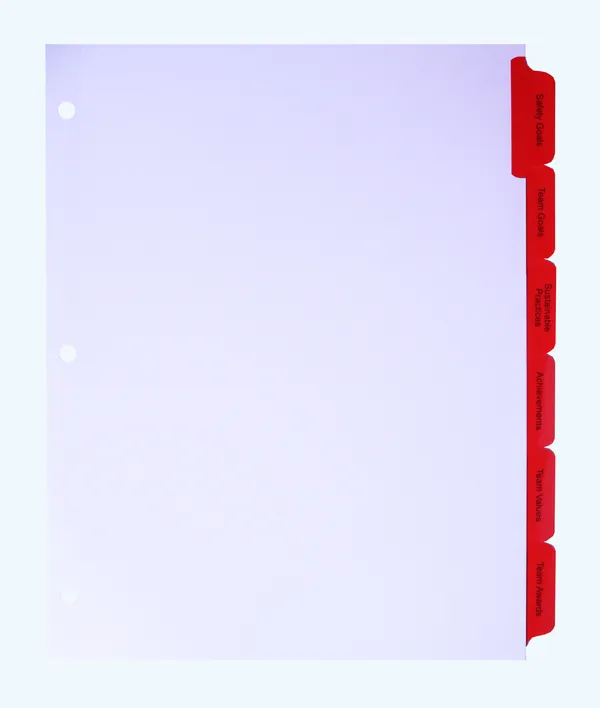
The record families the regulation already names
A brewery's daily records track materials received and used, beer produced, transfers for bottling and racking, and removals — the entries that must reconcile to the Brewer's Report of Operations. Wineries carry the parallel set behind the Report of Wine Premises Operations; distilled spirits plants keep production, storage and processing records that TTB expects to be well organized and readily available for inspection.
Tab the binder to those names — the regulation's names, not the office's nicknames — and the auditor's request maps straight onto your tabs. Common structures run ten to fifteen sections, which suits the 1/10 through 1/15 cuts.
- Materials received and used · production · transfers · removals
- Report-of-operations support, month by month
- Inventories · losses · tax determination · correspondence with TTB
When the audit letter arrives, assembly is the job
A TTB audit starts with a letter listing the records and reports to be reviewed, and the agency's own advice is to gather everything requested as soon as possible. Producers whose binders already mirror the record families answer that letter with a cart, not a scramble.
The audit-response binder itself is a repeatable structure — the requested reports, the daily records behind them, inventory counts, and the correspondence log — and a saved tab design means the next letter, or the other location's letter, assembles the same way.
Poly, because production floors are wet
Brewhouse, cellar, bottling line, rickhouse: the places where daily entries actually happen are hostile to paper. Poly tabs wipe clean, shrug off water, wort and sanitizer, and flex instead of creasing — the right call for the working binders that live at the point of production.
Office sets — the retention archive, the report-support binders, the audit file — do well in Mylar-reinforced paper at lower cost, in 19 Mylar colors so beer, wine and spirits records (or locations, or years) block by color at a glance.
- Poly for brewhouse, cellar and bottling-line binders
- Mylar-reinforced paper for the office archive and audit file
- Color-block by commodity, location or year
Multi-site producers and the consultants who serve them
A producer with two breweries and a distillery wants every location's records to open the same way — and the compliance consultancies that run mock audits across dozens of client premises want the same thing at portfolio scale. One saved design covers every site, and every reorder matches exactly.
The three-year retention requirement quietly multiplies volume: each year's records join the archive rather than replacing it, so a producer eventually maintains three years of identically tabbed binders per record family.
Ordering for a producer or compliance consultancy
An emailed purchase order is treated as the order — Net-30 invoicing, W-9s and vendor forms routine, published per-set pricing so the requisition writes itself. Minimum 25 sets with volume pricing past 1,000; paper produces in about 5 business days from proof approval and poly in about 15, with a free PDF proof first.
Tabzoola manufactures the index tabs and does not provide compliance advice or assess whether any recordkeeping system meets TTB requirements — your compliance officer or consultant owns the section list; we print it exactly.
Specs, minimums, and pricing at a glance
TTB Compliance Binder Tabs — what you can choose, what a set costs, and how fast it ships.
- Minimum order
- 25 sets
- Paper price, 5-tab set
- $5.45 per set at 25 sets, $2.35 at 100 sets, $1.57 at 250 sets. The size most suppliers quote — compare this one.
- Paper price, 12-tab set
- $11.40 per set at 25 sets, $5.22 at 100 sets, $3.60 at 250 sets. One price, setup included — nothing is added at checkout.
- Poly price, 12-tab set
- $53.20 per set at 25 sets, $22.84 at 100 sets, $14.08 at 250 sets. Setup included; poly is screen printed, so the per-set price falls sharply on longer runs.
- How you order
- Design online and see the exact price live, then buy by card — no quote form, no sales call.
- Materials
- 90# or 110# index paper, with optional Mylar edge reinforcing; .015 gauge solid poly (plastic) — wipe-clean and tear-resistant.
- Colors & cuts
- 19 Mylar colors on paper and 11 poly colors, mixable tab by tab. Every cut from 1/2 to 1/15, up to 150 tabs per set across banks.
- Printing & finishing
- 1- or 2-sided, up to 2 lines of text per tab, 3-hole punching, collated sets ready to assemble.
- Proof
- A free PDF proof is emailed before printing — nothing prints until you approve it.
- Production
- about 5 business days for paper, about 15 for poly, from proof approval. Free UPS Ground on US orders over $75.
- Made in
- Schaumburg, Illinois, USA — manufactured by Anselmo Die & Index, printing tabs since 1993.
Frequently asked questions
What are TTB compliance binder tabs?
Printed divider tabs that organize an alcohol producer's federal records — daily operations records, report-of-operations support, transfers, inventories, tax determination and TTB correspondence — into binders tabbed to the regulation's own record families. Tabzoola prints them to your compliance officer's section list, collated, in wipe-clean poly for production areas or Mylar-reinforced paper for the office archive.
Why do tabs matter for a TTB audit?
Because TTB's own audit guidance identifies missing or disorganized records as the most frequently cited compliance issue across brewery, winery and DSP audits, and an audit begins with a letter listing exactly what will be reviewed. Records filed behind tabs that mirror the regulation's record families can be produced while the auditor waits — which is the difference between an audit that reviews your records and one that writes you up for them.
How should a brewery's records binder be tabbed?
To the families the daily-records rule names: materials received and used, beer produced, transfers for bottling and racking, removals, inventories and losses, plus report-of-operations support month by month and a TTB correspondence section. Ten to fifteen tabs is typical, suiting the 1/10 to 1/15 cuts, with the same logic running in parallel for wine premises and DSP records.
Paper or poly for brewery and distillery binders?
Poly at the point of production — brewhouse, cellar, bottling line and rickhouse binders get wet, and poly wipes clean and does not tear. Mylar-reinforced paper suits the office archive and audit files at lower cost. Most producers run both from one shared design, and the three-year retention clock means each year's archive set joins the last rather than replacing it.
Can every location in a multi-site operation get identical sets?
Yes — the design is saved once and every site or client premises reorders against it, which is exactly what compliance consultancies running mock audits across a portfolio want: every binder at every premises opens the same way.
Do you help decide what sections TTB requires?
No — Tabzoola manufactures the index tabs and does not provide compliance advice or assess any recordkeeping system against 27 CFR. The section list belongs to your compliance officer or consultant; we print it exactly, with a free PDF proof before anything runs.
Free resources
Customer Reviews
We had a deadline to get 50 presentation books out, and our current tab supplier couldn't deliver the tabs that we needed on time. I worked directly with Justin and he was able to get our order manufactured and shipped out within days. The order arrived in time for us to complete our presentations, and the tabs looked great. This type of amazing customer service is very hard to find nowadays, but I'm thrilled to now have a supplier that I can count on.
Lamar, thank you — a deadline like yours is exactly what the shop is built for. The moment Justin heard it, your deadline became our deadline, and your order was manufactured and out the door in days. Rush work only counts when it arrives looking right, so "the tabs looked great" is the part we're proudest of. Count on us for the next one — we'll be here. John Anselmo, Tabzoola
Justin was so nice to work with ! He answered all my questions and now I feel like an expert :)
Megan, thank you for the kind words — I'll pass them straight to Justin. Getting every question answered before anything prints is exactly how we like to work, so "now I feel like an expert" is about the best review we could ask for. Whenever your next set of tabs comes up, your questions are always welcome. John Anselmo, Tabzoola
Glad I found you online. You're approximately 30 percent less than my old supplier and easier to work with. I'll be back.
Thank you, Ben — the price is no accident. We publish the whole table, setup included, so the number you see while you design is the number on the invoice. Glad the switch was easy, and we'll be ready when you are. — Tabzoola
I can't say enough about how great Justin was helping me with my order. After I approved the order he took time to call me to ask if i was sure about a decision to use next day delivery on the whole order when only a partial would keep me going while the rest of the order shipped ups ground. He saved me a ton of money. Thank you for caring about your customers. I wish more people were like you.
Thank you, Amy — I'll make sure Justin sees this. Splitting the shipment so only the part you needed went next-day was the right call, and it's the kind of thing we'd rather catch on the phone than have you find on the invoice. Anyone here would have made that call. Thank you for taking the time to write it down. — Tabzoola
My old supplier went out of business. You guys produced an exact copy of what we've been using. Thank you!!!
Thank you, Perri — losing a supplier you've used for years is a real headache, and matching a set you already rely on is the kind of job we like. If you ever need another one matched, a photo of an existing tab is enough for us to pick up the titles and the colors. Glad we could keep you running. — Tabzoola
Tabs came out better than expected. Will definitely be back.
Thank you, Joan — better than expected is a good place to land. The part people usually don't expect is the make: real die-cut tabs on index stock, with the Mylar bonded on both sides of the extension, which is where tabs tear first. We'll be ready whenever you need the next run. — Tabzoola
Very easy to use.
Thank you, Pat — short, and the best kind. Easy is the whole thing we were aiming for, so that is good to hear. Ready whenever you need more. — Tabzoola
You guys made ordering easy :)
Thanks, Louie — easy is the goal, and hearing it beats any feature list. Everything's printed and die-cut here in Schaumburg, so if anything ever isn't easy, you're one call from the people who made it. — Tabzoola
Very seldom do you see orders handled in such a professional manner. Thank you for a great job!
Thank you, Sherri — that’s a compliment we don’t take lightly. Every order here gets the same handling: a free proof before anything prints, and one shop seeing it through from die-cut to the box. Glad yours showed it. — Tabzoola
Very impressed how easy it was to order our index tabs. Will definitely be back for future orders!
Thank you, Anna — glad ordering was easy, that's the way it should be. And since you mentioned coming back: your design is saved, so the next run is a one-click reorder whenever you need it. — Tabzoola
Turned out perfect!
Thank you, Beth — "turned out perfect" is the best thing we can hear. Every set is die-cut and printed in our own shop in Schaumburg, so the people who made yours are the ones who checked it before it shipped. We'll be ready whenever you need the next one.
They looked great and saved hours of collating :)
Thank you, Chris — collating is exactly the labor we're trying to take off your desk. Your sets came off the line already in order, so nobody had to stack them by position. Glad it showed. We'll be ready for the next run. — Tabzoola
Thank's for the great service. Will be back for future orders.
Thanks, Greg — that's exactly what we like to hear. We'll be ready whenever the next set comes up. — Tabzoola
I'm truly impressed how easy it was to order.
Thanks, Tony — easy is exactly what we were going for, so that's good to hear. Your design is saved whenever you need more. — Tabzoola
Easy to order, they came out perfect!
Thank you, Nancy — "came out perfect" is exactly what we aim for. We've got your design saved whenever you need more. — Tabzoola
Thanks, Kim — that's what we were going for. The designer is meant to get you to a proof in a couple of minutes, not an afternoon. We're here whenever you need another set. — Tabzoola
Tabs turned out great, and the service was above and beyond.
Thank you, Jessica — service is the part we can't automate, so that means a lot. The tabs and the phone come from the same building in Schaumburg, which is the whole idea. Your design is saved whenever you need another run. — Tabzoola
Live pricing as you configure — no account needed. Free shipping over $75.
If it isn’t what you approved on the proof, we reprint it — or refund it. 30 days from delivery.
Helpful guides & tools
More tab types
- Index Tab Colors →
- Unpunched Index Tabs (No Holes) →
- Custom Book Tabs →
- Resident Chart Tabs for Long-Term Care & Skilled Nursing →
- Binder Tabs, Printed to Your Sections →
- Legal Exhibit Tabs & Case Binder Dividers →
- Custom Medical Chart Dividers & Tabs — From $5.45/Set →
- Numbered Index Tabs — Any Range You Need →
- Alphabetical Index Tabs — A to Z and Beyond →
- Collated Copy Tabs →
- Calendar Tabs, January to December →
- Custom Mylar Tab Dividers (Reinforced Edge Index Tabs) →
- Custom Tabs for Binders →
- Custom Poly (Plastic) Index Tab Dividers →
- Blank Index Tabs →
- Color-Coded Index Tabs →
- Roman Numeral Index Tabs →
- Financial & Tax Binder Tabs →
- Wealth Management & Client Review Binder Tabs →
- Bottom Tab Dividers & Hanging Tabs →
- Real Estate & Title Closing Tabs →
- Presentation & Proposal Binder Tabs →
- School, Teacher & Curriculum Tabs →
- Operations, Safety & Training Manual Tabs →
- Insurance & Claims File Tabs →
- 5 Tab Dividers, Printed to Your Sections →
- 8 Tab Dividers, Printed to Your Sections →
- 3 Tab Dividers, Printed to Your Sections →
- 4 Tab Dividers, Printed to Your Sections →
- 7 Tab Dividers, Printed to Your Sections →
- 9 Tab Dividers, Printed to Your Sections →
- 11 Tab Dividers, Printed to Your Sections →
- 14 Tab Dividers, Printed to Your Sections →
- 6 Tab Dividers, Printed to Your Sections →
- 13 Tab Dividers, Printed to Your Sections →
- Custom Tab Sets, Priced Per Set →
- Pre-Printed Binder Tabs, With Your Own Titles →
- 10 Tab Dividers, Printed to Your Sections →
- Custom 12-Tab Dividers (1/12-Cut) →
- Custom 15-Tab Dividers (1/15-Cut) →
- Custom 16-Tab Dividers (Two Banks of Eight) →
- Custom 20-Tab Dividers (Two Banks of Ten) →
- Custom 25-Tab Dividers (Exhibits 1–25) →
- Custom Paper Index Tabs →
- Government & Municipal Index Tabs →
- Church & Ministry Index Tabs →
- Custom Estate Planning Tabs & Binder Dividers →
- Nonprofit & Board Book Tabs →
- Dental Chart Tabs →
- Accounting & Audit Workpaper Tabs →
- HR & Employee Handbook Tabs →
- Insurance Policy Binder Tabs →
- Construction & Contractor Project Tabs →
- Manufacturing & ISO QMS Tabs →
- University & Research Binder Tabs →
- Trucking & Logistics Tabs →
- Automotive & Dealership Tabs →
- Hospitality & Restaurant Tabs →
- IT & Data Center Runbook Tabs →
- Small Batch Custom Tabs — From Just 25 Sets →
- Fast Custom Tabs — When the Deadline Is Real →
- Stop Building Exhibit Sets One Stock Tab at a Time →
- IEP Binder Tabs for School Districts →
- Tenant File Tabs for Affordable Housing Compliance →
- Behavioral Health Chart Tabs →
- Chiropractic Chart Tabs →
- Veterinary Chart Tabs →
- Franchise Operations Manual Tabs →
- Fire & EMS Protocol Binder Tabs →
- School Emergency Plan Binder Tabs →
- SPCC & SWPPP Plan Binder Tabs →
- HACCP & Food Safety Plan Binder Tabs →
- Hospital Emergency Plan & HICS Binder Tabs →
- Cannabis Compliance & SOP Binder Tabs →
- Childcare & Daycare Licensing Binder Tabs →
- Athletic Emergency Action Plan Binder Tabs →
- Water & Wastewater O&M Manual Binder Tabs →
- Business Continuity Plan Tabs →
- Regulatory Binder Tabs for Clinical Research →
- Aviation Manual Tabs, Printed to Your Sections →
- Loan & Credit File Tabs, Printed to Your Checklist →
- Immigration Petition Tabs, Printed to Your Exhibit List →
- Government Proposal & RFP Tabs →
- Law Office Binder Tabs →
- Trust Account Audit Binder Tabs →
- Elevator Maintenance Record Tabs →
- DEA Compliance Binder Tabs →
- Fire Protection ITM Record Tabs →
- Grant File & Single Audit Tabs →
- Individual & Replacement Index Tabs →
- Patient Chart Tabs for Clinics & Practices →
- Medical Chart Divider Tabs — the Standard Sets →
- Plastic Tab Dividers, Custom Printed →