Dental Chart Tabs
Tabzoola prints custom dental chart tabs to your own sections, such as exam, x-rays, treatment plan and billing, color-coded and collated for every chart. Wipe-clean poly or paper, priced online from $136.25 for 25 sets of 5 tabs, with a free PDF proof.
Tabzoola prices 25 sets of 5 custom paper tabs at $5.45 a set, $136.25 total — delivered free.
Setup included. Instant PDF proof before anything prints. Price it anywhere else first — we’d rather you did.
Need them fast? Tick 3-Day Rush at checkout (+40%, $75 minimum) and it ships 3 business days after you approve your proof. See your delivery date →
Tabzoola is a US manufacturer and supplier of custom dental chart dividers, manufactured to order at our own plant in Schaumburg, Illinois — Tabzoola's tabs are made at the Anselmo Die & Index, Inc. plant, die-cutting index tabs since 1993 and shipping nationwide.
A dental practice keeps files moving all day between the front desk, the operatory and billing, and color-coded chart tabs are what let staff flip straight to the right section. Tabzoola prints custom dental chart dividers to your own section names and color scheme — collated and ready to assemble for every chart.
Choose wipe-clean poly for files handled in operatories and exam rooms, or Mylar-reinforced paper for a lower-cost set that still resists tearing. Every order is manufactured to order in our Schaumburg, Illinois plant.
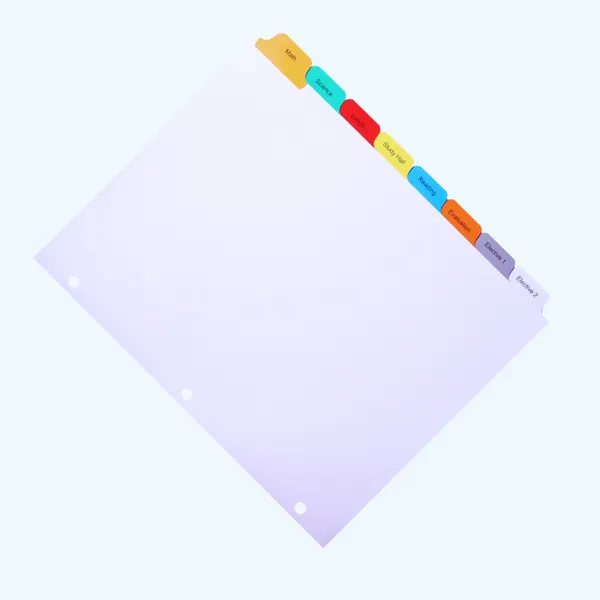

Color-coded sections for fast chart lookup
Assign a color to each section — exam, x-rays/imaging, treatment plan, perio, prescriptions, and billing — so the team finds the right place at a glance. Tabzoola offers 19 Mylar colors and 11 poly colors, and you can mix colors within a single chart set. Multi-doctor practices can run several standardized layouts under one color scheme.
- Exam, imaging, treatment, and labs section tabs
- Prescription / medication and billing dividers
- Color-coded for fast lookup (19 Mylar / 11 poly)
- Collated chart sets, 3-hole punched, Mylar on every paper tab, optional edge reinforcing
The dental chart spine
A dental chart repeats a short, stable set of sections across every patient, which is what makes printing them worthwhile rather than labelling by hand. Most practices index around the clinical record and the money: the exam and health history, radiographs, the periodontal chart, the treatment plan, progress and clinical notes, prescriptions, consents, and insurance and billing.
Practices with hygiene running alongside restorative often split perio into its own section so the hygienist is not paging through treatment planning to chart pockets. That is exactly the kind of detail a stock divider pack cannot accommodate and a printed set can.
- Health History · Exam · Radiographs · Perio Chart
- Treatment Plan · Progress Notes · Prescriptions
- Consents · Insurance & Billing · Correspondence
Printed text, not hot-stamped — and why it reads better
Chart tabs are labelled two different ways in this industry. Traditional medical and dental suppliers hot-stamp a limited set of standard titles onto pre-made stock, which is fast for them and is why the stock catalogue always shows the same sections. Tabzoola prints your text directly, which is why the wording can be anything your practice uses rather than anything a catalogue offers.
That difference shows up in what you can put on a tab. Print handles longer titles, mixed case, your own abbreviations, and second-line text where a section needs it — one or two sides. A stock hot-stamped tab that says CLINICAL is a compromise if your chart actually separates Clinical Notes from Clinical Photos.
- Your exact wording, not a catalogue's standard titles
- 1- or 2-sided printing, longer titles and second lines
- Black or white ink on poly — white pops on dark colours
Small packs versus a set built for the practice
Search results for dental chart dividers mix two very different products. Small retail packs sell for around thirteen dollars and contain a handful of pre-printed generic tabs, enough to fix one chart. Custom manufacturing starts at a case quantity and is what a practice buys when every chart in the cabinet needs to match.
The per-set economics are the part that surprises people. Paper chart sets run $8.00 per set at 25 sets, $3.58 at 100 and $2.44 at 250 — setup included in the price shown. A 5-tab set is $5.45 per set at 25 and $1.57 at 250. At 250 sets a fully custom divider set built to your own section names costs less per chart than a generic retail pack, which is the opposite of what the price of a single pack suggests.
- Minimum 25 sets — enough to re-chart a small practice at once
- $8.00/set at 25 · $3.58 at 100 · $2.44 at 250, setup included · 5-tab set $5.45 at 25, $1.57 at 250
- Published pricing, no quote step — the price updates as you build
The practice went digital and still keeps paper
Almost every dental practice runs a practice-management system, and almost every one still has a filing cabinet. The things that stay on paper are the things that arrive on paper or need a signature: signed consents and financial agreements, referral letters and specialist reports, insurance correspondence, lab slips, and older records that predate the current system.
That residual file is smaller than the old full chart, which changes what it needs. Fewer sections, but the ones that remain get pulled under pressure — a consent produced during a dispute, a referral letter found while the specialist is on hold. A six to eight tab set indexed to what the practice actually still keeps beats a fifteen-tab legacy layout with half the sections empty.
Specialty practices index differently
General practice is the baseline, but the chart changes shape by specialty. Orthodontic files carry a long treatment arc — records, cephalometric and panoramic imaging, appliance history, adjustment visits, retention — and stay open for years. Oral surgery files are shorter and heavier on consents, medical history, imaging and post-operative instructions. Periodontal practices give charting and maintenance recall their own sections.
Because the tabs are printed rather than picked from a catalogue, a specialty practice gets its own index instead of adapting a general-practice set. Multi-doctor groups running more than one specialty commonly order two or three layouts under one colour scheme, so a chart moving between doctors still reads the same way.
- Ortho — records, imaging, appliances, adjustments, retention
- Oral surgery — history, consents, imaging, post-op
- Perio — charting, scaling and root planing, maintenance recall
What a printed set costs against a stock pack
Custom chart dividers are usually assumed to be the expensive option, and at the quantities a practice actually buys they are not. Paper chart sets run $8.00 per set at 25 sets, $3.58 at 100 and $2.44 at 250, setup included. A 5-tab set is $5.45 per set at 25 and $1.57 at 250. Poly runs higher because the material costs more and it lasts accordingly.
That is per complete set, not per tab, and there is no quote step — the price updates as you build the set online. A practice replacing charts once and reordering the same design for years is comparing a one-time design against a stock pack that never quite matches the sections it actually uses.
- Minimum 25 sets, volume pricing to 1,000+, setup included
- About 5 business days for paper, 15 for poly, from proof approval
- Free PDF proof before anything prints
Wipe-clean poly for clinical handling
Charts that travel between operatories hold up best in poly (plastic), which is water-resistant and wipes clean. Mylar-reinforced paper costs less and works well for records-room files. Both print on one or two sides.
Specs, minimums, and pricing at a glance
Dental Chart Tabs — what you can choose, what a set costs, and how fast it ships.
- Minimum order
- 25 sets
- Paper price, 5-tab set
- $5.45 per set at 25 sets, $2.35 at 100 sets, $1.57 at 250 sets. The size most suppliers quote — compare this one.
- Paper price, 8-tab set
- $8.00 per set at 25 sets, $3.58 at 100 sets, $2.44 at 250 sets. One price, setup included — nothing is added at checkout.
- Poly price, 8-tab set
- $40.80 per set at 25 sets, $16.56 at 100 sets, $9.92 at 250 sets. Setup included; poly is screen printed, so the per-set price falls sharply on longer runs.
- How you order
- Design online and see the exact price live, then buy by card — no quote form, no sales call.
- Materials
- 90# or 110# index paper, with optional Mylar edge reinforcing; .015 gauge solid poly (plastic) — wipe-clean and tear-resistant.
- Colors & cuts
- 19 Mylar colors on paper and 11 poly colors, mixable tab by tab. Every cut from 1/2 to 1/15, up to 150 tabs per set across banks.
- Printing & finishing
- 1- or 2-sided, up to 2 lines of text per tab, 3-hole punching, collated sets ready to assemble.
- Proof
- A free PDF proof is emailed before printing — nothing prints until you approve it.
- Production
- about 5 business days for paper, about 15 for poly, from proof approval. Free UPS Ground on US orders over $75.
- Made in
- Schaumburg, Illinois, USA — manufactured by Anselmo Die & Index, printing tabs since 1993.
Frequently asked questions
What sections go in a dental chart?
Most practices index around Health History, Exam, Radiographs, Perio Chart, Treatment Plan, Progress Notes, Prescriptions, Consents, and Insurance and Billing. Practices running hygiene alongside restorative usually give perio its own tab so the hygienist is not paging through treatment planning. Because the tabs are printed to your wording, the chart matches how your practice actually files.
Why are custom dental chart dividers cheaper than small retail packs?
Because the comparison is per set rather than per pack. A retail pack of generic pre-printed tabs runs around thirteen dollars and fixes one chart. Custom sets are $8.00 per set at 25 sets, $3.58 at 100 and $2.44 at 250 with setup included — so at volume a fully custom set built to your own section names costs less per chart than a generic pack, and every chart in the cabinet matches. A 5-tab set is $5.45 per set at 25 and $1.57 at 250.
Can you print our own section names, or only standard titles?
Your own. Traditional suppliers hot-stamp a fixed catalogue of standard titles onto stock dividers, which is why the same sections appear everywhere. We print your text directly, so titles can be any length, mixed case, your own abbreviations, and second-line text where a section needs it — on one or both sides.
We're mostly digital. Do we still need custom chart tabs?
Most practices that ask this still keep a paper file for signed consents and financial agreements, referral letters and specialist reports, insurance correspondence, lab slips, and pre-system records. That residual file is smaller than the old full chart, so a six to eight tab set indexed to what you actually still keep works better than a legacy fifteen-tab layout with empty sections.
Do orthodontic or oral surgery practices use a different set?
Usually yes. Ortho files run a long treatment arc — records, cephalometric and panoramic imaging, appliance history, adjustments, retention. Oral surgery files are shorter and weighted toward medical history, consents, imaging and post-operative instructions. Multi-specialty groups often order two or three layouts under one colour scheme so charts read the same across doctors.
Are poly chart tabs better for dental files?
Poly (plastic) tabs are water-resistant and wipe clean, so they hold up well in operatories. Mylar-reinforced paper costs less and is fine for records-room files — most practices choose based on handling and budget.
Can each chart section be a different color?
Yes. Assign a different color to each tab (19 Mylar colors, 11 poly colors) so exam, radiographs, perio, treatment and billing sections are color-coded for fast lookup.
How fast can chart tabs ship?
Paper sets ship in about 5 business days and poly sets in about 15 business days from proof approval. The minimum order is 25 sets.
Customer Reviews
We had a deadline to get 50 presentation books out, and our current tab supplier couldn't deliver the tabs that we needed on time. I worked directly with Justin and he was able to get our order manufactured and shipped out within days. The order arrived in time for us to complete our presentations, and the tabs looked great. This type of amazing customer service is very hard to find nowadays, but I'm thrilled to now have a supplier that I can count on.
Lamar, thank you — a deadline like yours is exactly what the shop is built for. The moment Justin heard it, your deadline became our deadline, and your order was manufactured and out the door in days. Rush work only counts when it arrives looking right, so "the tabs looked great" is the part we're proudest of. Count on us for the next one — we'll be here. John Anselmo, Tabzoola
Justin was so nice to work with ! He answered all my questions and now I feel like an expert :)
Megan, thank you for the kind words — I'll pass them straight to Justin. Getting every question answered before anything prints is exactly how we like to work, so "now I feel like an expert" is about the best review we could ask for. Whenever your next set of tabs comes up, your questions are always welcome. John Anselmo, Tabzoola
Glad I found you online. You're approximately 30 percent less than my old supplier and easier to work with. I'll be back.
Thank you, Ben — the price is no accident. We publish the whole table, setup included, so the number you see while you design is the number on the invoice. Glad the switch was easy, and we'll be ready when you are. — Tabzoola
I can't say enough about how great Justin was helping me with my order. After I approved the order he took time to call me to ask if i was sure about a decision to use next day delivery on the whole order when only a partial would keep me going while the rest of the order shipped ups ground. He saved me a ton of money. Thank you for caring about your customers. I wish more people were like you.
Thank you, Amy — I'll make sure Justin sees this. Splitting the shipment so only the part you needed went next-day was the right call, and it's the kind of thing we'd rather catch on the phone than have you find on the invoice. Anyone here would have made that call. Thank you for taking the time to write it down. — Tabzoola
My old supplier went out of business. You guys produced an exact copy of what we've been using. Thank you!!!
Thank you, Perri — losing a supplier you've used for years is a real headache, and matching a set you already rely on is the kind of job we like. If you ever need another one matched, a photo of an existing tab is enough for us to pick up the titles and the colors. Glad we could keep you running. — Tabzoola
Tabs came out better than expected. Will definitely be back.
Thank you, Joan — better than expected is a good place to land. The part people usually don't expect is the make: real die-cut tabs on index stock, with the Mylar bonded on both sides of the extension, which is where tabs tear first. We'll be ready whenever you need the next run. — Tabzoola
Very easy to use.
Thank you, Pat — short, and the best kind. Easy is the whole thing we were aiming for, so that is good to hear. Ready whenever you need more. — Tabzoola
You guys made ordering easy :)
Thanks, Louie — easy is the goal, and hearing it beats any feature list. Everything's printed and die-cut here in Schaumburg, so if anything ever isn't easy, you're one call from the people who made it. — Tabzoola
Very seldom do you see orders handled in such a professional manner. Thank you for a great job!
Thank you, Sherri — that’s a compliment we don’t take lightly. Every order here gets the same handling: a free proof before anything prints, and one shop seeing it through from die-cut to the box. Glad yours showed it. — Tabzoola
Very impressed how easy it was to order our index tabs. Will definitely be back for future orders!
Thank you, Anna — glad ordering was easy, that's the way it should be. And since you mentioned coming back: your design is saved, so the next run is a one-click reorder whenever you need it. — Tabzoola
Turned out perfect!
Thank you, Beth — "turned out perfect" is the best thing we can hear. Every set is die-cut and printed in our own shop in Schaumburg, so the people who made yours are the ones who checked it before it shipped. We'll be ready whenever you need the next one.
They looked great and saved hours of collating :)
Thank you, Chris — collating is exactly the labor we're trying to take off your desk. Your sets came off the line already in order, so nobody had to stack them by position. Glad it showed. We'll be ready for the next run. — Tabzoola
Thank's for the great service. Will be back for future orders.
Thanks, Greg — that's exactly what we like to hear. We'll be ready whenever the next set comes up. — Tabzoola
I'm truly impressed how easy it was to order.
Thanks, Tony — easy is exactly what we were going for, so that's good to hear. Your design is saved whenever you need more. — Tabzoola
Easy to order, they came out perfect!
Thank you, Nancy — "came out perfect" is exactly what we aim for. We've got your design saved whenever you need more. — Tabzoola
Thanks, Kim — that's what we were going for. The designer is meant to get you to a proof in a couple of minutes, not an afternoon. We're here whenever you need another set. — Tabzoola
Tabs turned out great, and the service was above and beyond.
Thank you, Jessica — service is the part we can't automate, so that means a lot. The tabs and the phone come from the same building in Schaumburg, which is the whole idea. Your design is saved whenever you need another run. — Tabzoola
Live pricing as you configure — no account needed. Free shipping over $75.
If it isn’t what you approved on the proof, we reprint it — or refund it. 30 days from delivery.
Helpful guides & tools
More tab types
- Index Tab Colors →
- Unpunched Index Tabs (No Holes) →
- Custom Book Tabs →
- Resident Chart Tabs for Long-Term Care & Skilled Nursing →
- Binder Tabs, Printed to Your Sections →
- Legal Exhibit Tabs & Case Binder Dividers →
- Custom Medical Chart Dividers & Tabs — From $5.45/Set →
- Numbered Index Tabs — Any Range You Need →
- Alphabetical Index Tabs — A to Z and Beyond →
- Collated Copy Tabs →
- Calendar Tabs, January to December →
- Custom Mylar Tab Dividers (Reinforced Edge Index Tabs) →
- Custom Tabs for Binders →
- Custom Poly (Plastic) Index Tab Dividers →
- Blank Index Tabs →
- Color-Coded Index Tabs →
- Roman Numeral Index Tabs →
- Financial & Tax Binder Tabs →
- Wealth Management & Client Review Binder Tabs →
- Bottom Tab Dividers & Hanging Tabs →
- Real Estate & Title Closing Tabs →
- Presentation & Proposal Binder Tabs →
- School, Teacher & Curriculum Tabs →
- Operations, Safety & Training Manual Tabs →
- Insurance & Claims File Tabs →
- 5 Tab Dividers, Printed to Your Sections →
- 8 Tab Dividers, Printed to Your Sections →
- 3 Tab Dividers, Printed to Your Sections →
- 4 Tab Dividers, Printed to Your Sections →
- 7 Tab Dividers, Printed to Your Sections →
- 9 Tab Dividers, Printed to Your Sections →
- 11 Tab Dividers, Printed to Your Sections →
- 14 Tab Dividers, Printed to Your Sections →
- 6 Tab Dividers, Printed to Your Sections →
- 13 Tab Dividers, Printed to Your Sections →
- Custom Tab Sets, Priced Per Set →
- Pre-Printed Binder Tabs, With Your Own Titles →
- 10 Tab Dividers, Printed to Your Sections →
- Custom 12-Tab Dividers (1/12-Cut) →
- Custom 15-Tab Dividers (1/15-Cut) →
- Custom 16-Tab Dividers (Two Banks of Eight) →
- Custom 20-Tab Dividers (Two Banks of Ten) →
- Custom 25-Tab Dividers (Exhibits 1–25) →
- Custom Paper Index Tabs →
- Government & Municipal Index Tabs →
- Church & Ministry Index Tabs →
- Custom Estate Planning Tabs & Binder Dividers →
- Nonprofit & Board Book Tabs →
- Accounting & Audit Workpaper Tabs →
- HR & Employee Handbook Tabs →
- Insurance Policy Binder Tabs →
- Construction & Contractor Project Tabs →
- Manufacturing & ISO QMS Tabs →
- University & Research Binder Tabs →
- Trucking & Logistics Tabs →
- Automotive & Dealership Tabs →
- Hospitality & Restaurant Tabs →
- IT & Data Center Runbook Tabs →
- Small Batch Custom Tabs — From Just 25 Sets →
- Fast Custom Tabs — When the Deadline Is Real →
- Stop Building Exhibit Sets One Stock Tab at a Time →
- IEP Binder Tabs for School Districts →
- Tenant File Tabs for Affordable Housing Compliance →
- Behavioral Health Chart Tabs →
- Chiropractic Chart Tabs →
- Veterinary Chart Tabs →
- Franchise Operations Manual Tabs →
- Fire & EMS Protocol Binder Tabs →
- School Emergency Plan Binder Tabs →
- SPCC & SWPPP Plan Binder Tabs →
- HACCP & Food Safety Plan Binder Tabs →
- Hospital Emergency Plan & HICS Binder Tabs →
- Cannabis Compliance & SOP Binder Tabs →
- Childcare & Daycare Licensing Binder Tabs →
- Athletic Emergency Action Plan Binder Tabs →
- Water & Wastewater O&M Manual Binder Tabs →
- Business Continuity Plan Tabs →
- Regulatory Binder Tabs for Clinical Research →
- Aviation Manual Tabs, Printed to Your Sections →
- Loan & Credit File Tabs, Printed to Your Checklist →
- Immigration Petition Tabs, Printed to Your Exhibit List →
- Government Proposal & RFP Tabs →
- TTB Compliance Binder Tabs →
- Law Office Binder Tabs →
- Trust Account Audit Binder Tabs →
- Elevator Maintenance Record Tabs →
- DEA Compliance Binder Tabs →
- Fire Protection ITM Record Tabs →
- Grant File & Single Audit Tabs →
- Individual & Replacement Index Tabs →
- Patient Chart Tabs for Clinics & Practices →
- Medical Chart Divider Tabs — the Standard Sets →
- Plastic Tab Dividers, Custom Printed →