Water & Wastewater O&M Manual Binder Tabs
Water and wastewater O&M manual tabs are the numbered chapter dividers state guidance recommends for a plant's operations and maintenance binder. Tabzoola prints them to your plant's chapter list, numbers and names together if you like, in plant-proof poly, with a free PDF proof.
Tabzoola makes poly tabs for binders that get handled every day — priced live as you design, setup included, 25-set minimum. Instant PDF proof before anything prints.
Tabzoola is a US manufacturer and supplier of custom index tabs for water and wastewater operations and maintenance manuals, printed and die-cut to order in Schaumburg, Illinois. Tabzoola's tabs are made at the Schaumburg plant of its sister company, Anselmo Die & Index, Inc., a family-owned index tab manufacturer since 1993, and ship nationwide.
State guidance for treatment plant O&M manuals is unusually specific about the physical document: bind it in three-ring binders so it can be revised, and separate the chapters with numbered tabs. The format is part of the requirement, not an afterthought.
That is because the manual has two very different readers — a state reviewer approving it, and an operator on a night shift trying to find a shutdown sequence. Tabzoola prints the divider sets to the plant's own chapter list.
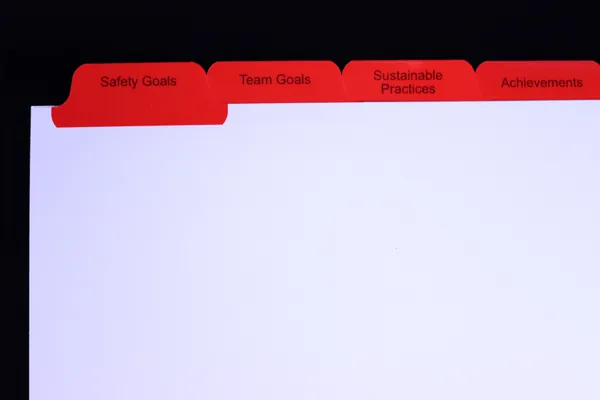
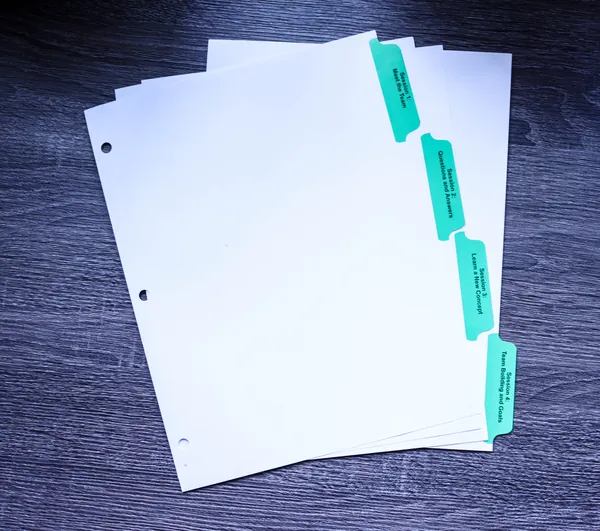
The guidance names the tabs
State environmental agencies publishing O&M manual guidelines say the manual should be bound in three-ring binders to accommodate future revisions, and that chapters should be separated with numbered tabs for ease of identification. That is rare — most compliance documents leave the physical form entirely to the writer.
It also makes the set easy to specify. Numbered tabs matching the chapter numbering survive every revision that replaces content without adding a chapter, which is most of them.
- 1 Facility Description · 2 Process Flow Diagram · 3 Design Criteria
- 4 Unit Processes · 5 Normal Operation · 6 Startup & Shutdown
- 7 Preventive Maintenance · 8 Equipment Records · 9 Spare Parts
- 10 Laboratory & Sampling · 11 Records & Reporting · 12 Safety
- 13 Emergency Response & Bypass · 14 Staffing & Certification · 15 Drawings
Two readers, one binder
The reviewer reads it once, front to back, checking that every required element is present and approvable. The operator never reads it that way — they open it to one unit process at 2am because a blower tripped, and they need the shutdown sequence and the alarm response, not the design criteria.
A numbered index serves the first reader and a colour scheme serves the second. Numbering the chapters keeps the manual mapped to the approval checklist; colouring the operational blocks — unit processes, maintenance, emergency — lets a night operator find the right chapter without reading fifteen labels.
The plant environment destroys paper
This binder does not live in an office. It lives in a control room, a blower building, a headworks, a chlorine room or a lab — humid by definition, often chemically aggressive, and handled by operators in work gloves who have just been outside.
Poly is the right default. It is tear-resistant, wipes clean, and survives conditions that curl and stain paper within a season. A copy kept in the utility's administrative office or filed with the state can be Mylar-reinforced paper at lower cost.
One utility, many facilities, one index
A municipal utility rarely runs one thing. There is a treatment plant, often two, plus lift stations, booster stations, wells, storage tanks and a collection or distribution system — each with its own manual or its own chapter in a larger one.
Standardising the tab set across all of them means an operator who transfers between facilities opens the same structure, and a supervisor auditing three sites is not relearning the layout each time. It also turns what looked like a two-binder order into a real run: control-room copy, maintenance copy, administrative copy and a state submission copy for each facility.
- Minimum 25 sets, volume pricing continuing past 1,000
- Saved design — a new lift station matches the plant exactly
- About 15 business days for poly from proof approval
Manuals are revised, which is why they are in binders
The reason the guidance calls for three-ring binders rather than bound volumes is explicit: manuals get revised. Equipment is replaced, a process is upgraded, a permit limit changes, a new unit comes online, and the manual has to reflect the plant as it actually runs rather than as it was designed.
A printed numbered index absorbs that. Replaced pages go behind the existing tab and the chapter numbering is untouched. When a genuine new chapter is added, edit the saved design and reorder — every facility and every copy updates together rather than diverging into several versions of the truth.
Operator certification makes the manual a training document
Operators are licensed by the state and have continuing-education obligations, and new operators are trained against the plant's own manual rather than a textbook. That makes the O&M manual the primary onboarding document at most utilities.
A manual somebody can navigate is a manual that actually gets used in training. Where the index is clear, a new operator can be sent to a specific chapter and process; where it is not, training defaults to shadowing, and the manual quietly becomes shelf furniture that only appears when the state asks for it.
Emergency response is the chapter that justifies the colour
Every O&M manual carries an emergency and bypass section — power failure, flooding, chemical release, equipment failure, unplanned discharge and the notification requirements that follow. It is the least-read chapter until the moment it is the only one that matters.
Giving it a distinct colour, separate from the operational blocks, is worth doing deliberately. An operator dealing with an unplanned discharge at 3am is under a reporting clock, and the difference between finding the notification procedure in five seconds and five minutes is a real one.
- Emergency & bypass in its own colour, distinct from operations
- Notification and reporting behind its own tab, not buried in the chapter
Specs, minimums, and pricing at a glance
Water & Wastewater O&M Manual Binder Tabs — what you can choose, what a set costs, and how fast it ships.
- Minimum order
- 25 sets
- Poly price, 12-tab set
- $53.20 per set at 25 sets, $22.84 at 100 sets, $14.08 at 250 sets. Setup included; poly is screen printed, so the per-set price falls sharply on longer runs.
- How you order
- Design online and see the exact price live, then buy by card — no quote form, no sales call.
- Materials
- .015 gauge solid poly (plastic) — wipe-clean and tear-resistant.
- Colors & cuts
- 11 poly colors, mixable tab by tab. Every cut from 1/2 to 1/15, up to 150 tabs per set across banks.
- Printing & finishing
- 1- or 2-sided, up to 2 lines of text per tab, 3-hole punching, collated sets ready to assemble.
- Proof
- A free PDF proof is emailed before printing — nothing prints until you approve it.
- Production
- about 15 for poly, from proof approval. Free UPS Ground on US orders over $75.
- Made in
- Schaumburg, Illinois, USA — manufactured by Anselmo Die & Index, printing tabs since 1993.
Frequently asked questions
What chapters should a water or wastewater O&M manual have tabs for?
Most follow the shape state guidance recommends: facility description, process flow diagram, design criteria, unit processes, normal operation, startup and shutdown, preventive maintenance, equipment records, spare parts, laboratory and sampling, records and reporting, safety, emergency response and bypass, staffing and certification, and drawings. Tabs are printed to your plant's own chapter list rather than a stock pack.
Why numbered tabs rather than named ones?
Because state guidance recommends numbered tabs matching the chapter numbering, and because it survives revision. Most manual updates replace content inside an existing chapter, so a numbered index stays correct where a purely descriptive one drifts. You can combine both — a number and a short chapter name on the same tab.
Should the manual be poly or paper?
Poly for any copy that lives at the facility. Control rooms, blower buildings, headworks, chlorine rooms and labs are humid and often chemically aggressive, and operators handle the binder in work gloves. Poly is tear-resistant and wipes clean; paper curls and stains within a season. An administrative office copy or a state submission copy can be Mylar-reinforced paper.
We run several facilities. Can they share one design?
Yes, and it is the main argument for printing. A utility typically has a treatment plant or two plus lift stations, booster stations, wells and storage — standardising the index means an operator transferring between facilities opens the same structure. Each facility also needs several copies: control room, maintenance, administration and the state submission.
How many tabs does an O&M manual usually need?
Twelve to fifteen chapters is typical, which suits the 1/12 and 1/15 cuts. Every cut from 1/2 to 1/15 is available, and the tab cut calculator turns a chapter count into the right cut and number of banks.
What happens when the plant is upgraded?
Revisions usually replace pages behind an existing numbered tab, so the index is untouched and you reprint pages rather than dividers — which is exactly why the guidance calls for three-ring binders. When a genuinely new chapter is added, edit your saved design and reorder so every facility and every copy updates together.
Free resources
Customer Reviews
First time we have ordered plastic tabs, printing was sharp and easy to read. Will definitely come back.
Thank you, Harvey — glad the printing came through sharp. That’s the part that takes real care on poly, since the ink has to sit on the plastic instead of soaking into paper the way it does on an index sheet. Your set is .015 poly, so it’ll wipe clean and should outlast the binder it’s in. We’ll be ready whenever you need the next one.
Live pricing as you configure — no account needed. Free shipping over $75.
If it isn’t what you approved on the proof, we reprint it — or refund it. 30 days from delivery.
Helpful guides & tools
More tab types
- Index Tab Colors →
- Unpunched Index Tabs (No Holes) →
- Custom Book Tabs →
- Resident Chart Tabs for Long-Term Care & Skilled Nursing →
- Binder Tabs, Printed to Your Sections →
- Legal Exhibit Tabs & Case Binder Dividers →
- Custom Medical Chart Dividers & Tabs — From $5.45/Set →
- Numbered Index Tabs — Any Range You Need →
- Alphabetical Index Tabs — A to Z and Beyond →
- Collated Copy Tabs →
- Calendar Tabs, January to December →
- Custom Mylar Tab Dividers (Reinforced Edge Index Tabs) →
- Custom Tabs for Binders →
- Custom Poly (Plastic) Index Tab Dividers →
- Blank Index Tabs →
- Color-Coded Index Tabs →
- Roman Numeral Index Tabs →
- Financial & Tax Binder Tabs →
- Wealth Management & Client Review Binder Tabs →
- Bottom Tab Dividers & Hanging Tabs →
- Real Estate & Title Closing Tabs →
- Presentation & Proposal Binder Tabs →
- School, Teacher & Curriculum Tabs →
- Operations, Safety & Training Manual Tabs →
- Insurance & Claims File Tabs →
- 5 Tab Dividers, Printed to Your Sections →
- 8 Tab Dividers, Printed to Your Sections →
- 3 Tab Dividers, Printed to Your Sections →
- 4 Tab Dividers, Printed to Your Sections →
- 7 Tab Dividers, Printed to Your Sections →
- 9 Tab Dividers, Printed to Your Sections →
- 11 Tab Dividers, Printed to Your Sections →
- 14 Tab Dividers, Printed to Your Sections →
- 6 Tab Dividers, Printed to Your Sections →
- 13 Tab Dividers, Printed to Your Sections →
- Custom Tab Sets, Priced Per Set →
- Pre-Printed Binder Tabs, With Your Own Titles →
- 10 Tab Dividers, Printed to Your Sections →
- Custom 12-Tab Dividers (1/12-Cut) →
- Custom 15-Tab Dividers (1/15-Cut) →
- Custom 16-Tab Dividers (Two Banks of Eight) →
- Custom 20-Tab Dividers (Two Banks of Ten) →
- Custom 25-Tab Dividers (Exhibits 1–25) →
- Custom Paper Index Tabs →
- Government & Municipal Index Tabs →
- Church & Ministry Index Tabs →
- Custom Estate Planning Tabs & Binder Dividers →
- Nonprofit & Board Book Tabs →
- Dental Chart Tabs →
- Accounting & Audit Workpaper Tabs →
- HR & Employee Handbook Tabs →
- Insurance Policy Binder Tabs →
- Construction & Contractor Project Tabs →
- Manufacturing & ISO QMS Tabs →
- University & Research Binder Tabs →
- Trucking & Logistics Tabs →
- Automotive & Dealership Tabs →
- Hospitality & Restaurant Tabs →
- IT & Data Center Runbook Tabs →
- Small Batch Custom Tabs — From Just 25 Sets →
- Fast Custom Tabs — When the Deadline Is Real →
- Stop Building Exhibit Sets One Stock Tab at a Time →
- IEP Binder Tabs for School Districts →
- Tenant File Tabs for Affordable Housing Compliance →
- Behavioral Health Chart Tabs →
- Chiropractic Chart Tabs →
- Veterinary Chart Tabs →
- Franchise Operations Manual Tabs →
- Fire & EMS Protocol Binder Tabs →
- School Emergency Plan Binder Tabs →
- SPCC & SWPPP Plan Binder Tabs →
- HACCP & Food Safety Plan Binder Tabs →
- Hospital Emergency Plan & HICS Binder Tabs →
- Cannabis Compliance & SOP Binder Tabs →
- Childcare & Daycare Licensing Binder Tabs →
- Athletic Emergency Action Plan Binder Tabs →
- Business Continuity Plan Tabs →
- Regulatory Binder Tabs for Clinical Research →
- Aviation Manual Tabs, Printed to Your Sections →
- Loan & Credit File Tabs, Printed to Your Checklist →
- Immigration Petition Tabs, Printed to Your Exhibit List →
- Government Proposal & RFP Tabs →
- TTB Compliance Binder Tabs →
- Law Office Binder Tabs →
- Trust Account Audit Binder Tabs →
- Elevator Maintenance Record Tabs →
- DEA Compliance Binder Tabs →
- Fire Protection ITM Record Tabs →
- Grant File & Single Audit Tabs →
- Individual & Replacement Index Tabs →
- Patient Chart Tabs for Clinics & Practices →
- Medical Chart Divider Tabs — the Standard Sets →
- Plastic Tab Dividers, Custom Printed →